


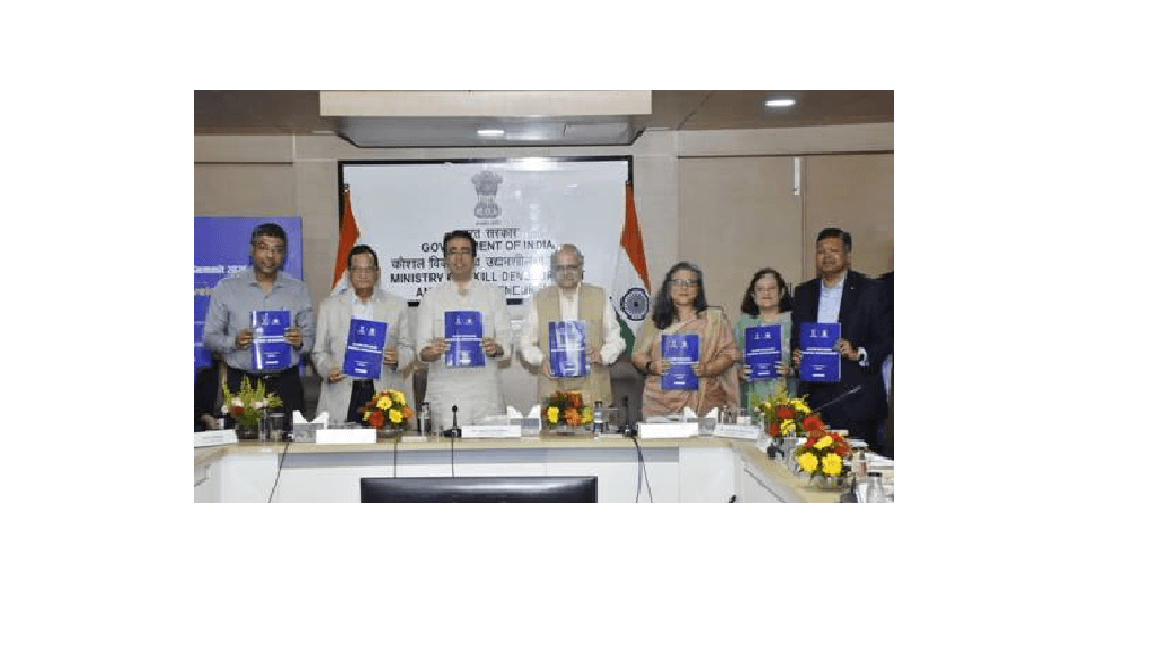
NEW DELHI,09 0CT 2025 – In a significant move aimed at transforming the lives of India’s informal workforce, Shri Jayant Chaudhary, Minister of State
(Independent Charge) for Skill Development & Entrepreneurship and Education, along with Shri Suman Bery, Vice Chairperson of NITI Aayog, today launched
a pioneering report titled “AI for Inclusive Societal Development.”
The study, developed by NITI Aayog’s Frontier Tech Hub in partnership with Deloitte, marks a first-of-its-kind effort to systematically harness Artificial
Intelligence (AI) for the benefit of the informal sector, which comprises 490 million workers and contributes nearly half of the nation’s GDP.
The launch event saw the participation of senior officials including Secretaries from the Ministries of Skill Development, Labour and Employment,
and Electronics and IT, underscoring a whole-of-government approach to integrating technology with skilling and workers’ welfare.
Shifting the AI Focus to the Grassroots
While global AI discussions have largely centered on the formal economy, this report deliberately shifts the focus to the informal worker—the farmer,
artisan, construction worker, and domestic helper—who often remains excluded from formal systems of social protection and productivity enhancement.
Shri Jayant Chaudhary emphasized the moral and economic imperative of this mission, stating, “Empowering India’s informal workers is not just an economic priority, it is a moral imperative… This mission will ensure that every worker—whether a farmer, artisan, or healthcare aide—has the skills, tools, and opportunities needed to thrive in the digital economy of tomorrow.”
Mission Digital ShramSetu: A Bridge to the Future
The report proposes the launch of ‘Mission Digital ShramSetu’—a national mission designed to build an ecosystem where AI and frontier technologies like
blockchain and immersive learning are accessible and affordable for every worker.
The mission aims to tackle critical constraints faced by informal workers, including:
- Financial insecurity
- Limited access to markets
- Lack of formal skilling and social protection
The report issues a stark warning, noting that at the current pace, the average annual income of informal workers may stagnate around $6,000 by 2047,
far below the $14,500 threshold required for India to achieve high-income status. This makes immediate, coordinated action imperative.
Collaboration is Non-Negotiable
Leadership from NITI Aayog stressed that technology alone is not a silver bullet. Mr. B.V.R. Subrahmanyam, CEO of NITI Aayog, asserted,
“If we are serious about transforming the lives of India’s 490 million informal workers, collaboration is not optional—it is non-negotiable.”
Echoing this sentiment, Ms. Debjani Ghosh, Chief Architect of the Frontier Tech Hub, added, “For India to achieve its $30 trillion Viksit Bharat 2047 aspiration, we cannot leave behind the 490 million workers who power our economy every day.”